Tag: PSTN Switch Off

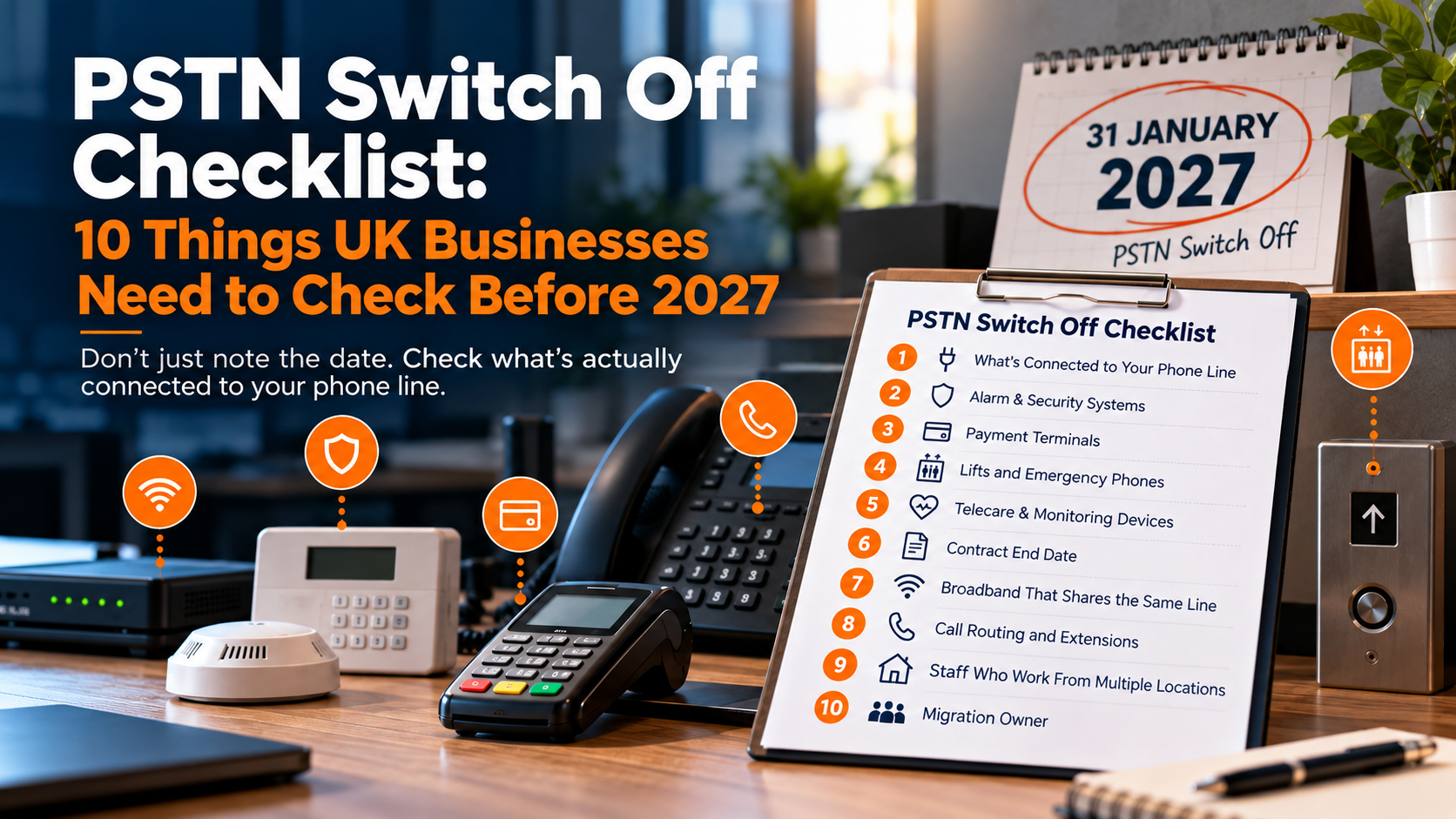
  • PSTN Switch Off Checklist: 10 Things UK Businesses Need to Check Before 2027

    PSTN Switch Off Checklist: 10 Things UK Businesses Need to Check Before 2027

    Ask ten business owners about the PSTN switch off and nine will tell you the date. Ask them 

    what’s actually connected to their phone line, and the room goes quiet. 

    That’s the real risk here. Not the deadline itself. 31 January 2027, confirmed by Openreach. 

    But the stuff nobody thinks to check until it stops working. After helping more than 500 UK 

    organisations through this exact migration, we’ve noticed the same blind spots come up again 

    and again. 

    So, here’s the checklist we’d actually run through with you. Ten things worth confirming 

    before your exchange migrates, not after. 

    1. What’s Physically Plugged into Your Phone Line 

    Start here, because everything else follows from it. Most businesses know their handsets are 

    connected. Fewer remember the fax machine in the back office, the intercom by the loading 

    bay, or the old modem nobody’s touched in years. Walk the building. List everything. 

    2. Alarm and Security Systems 

    Intruder alarms and fire systems that dial out over a phone line need separate sign off from 

    whoever installed them. This isn’t something your phone provider handles automatically, and 

    it’s not something to leave until the week of the switch. 

    3. Card Payment Terminals 

    Older chip and PIN machines sometimes rely on a phone line to process transactions. If yours 

    does, check with your payment provider now. A till that can’t take payment is a much bigger 

    problem than a phone call that rings through differently. 

    4. Lift and Emergency Phones 

    Building lifts often have a dedicated emergency line. So do some door entry systems. These 

    tend to be forgotten because they’re rarely used, which is exactly why they need checking, not 

    ignoring. 

    5. Telecare and Monitoring Devices 

    If your business supports vulnerable customers, staff or tenants, care settings, sheltered 

    housing, some healthcare providers, check for any telecare devices connected via landline. 

    These were a major reason BT pushed the original deadline back, and they need individual 

    attention. 

    6. Your Current Contract End Date 

    Some existing phone contracts run past January 2027 without accounting for the switch off at 

    all. Check what you’re actually committed to, and when, so you’re not locked into a service 

    that’s about to stop existing. 

    7. Broadband That Shares the Same Line 

    Older broadband connections, particularly ADSL, run over the same copper infrastructure 

    being retired. If your internet and phone line come from the same source, that’s one 

    conversation, not two. 

    8. Call Routing and Extensions 

    If calls currently route through a receptionist, an IVR, or between several extensions, map out 

    how that actually works before you migrate. It’s far easier to replicate, or improve, a call flow 

    you understand than one that’s grown organically over a decade. 

    9. Staff Who Work From Multiple Locations 

    Hybrid and multi-site working exposes the limits of a fixed landline fast. If your team needs 

    to answer business calls from home, a second office, or a mobile, that’s a decision worth 

    making deliberately rather than inheriting by accident. 

    10. Who’s Actually Accountable for the Migration 

    Someone in the business needs to own this. Not “IT will sort it eventually”, a named person, 

    with a date, checking the above list off. Migrations that drift without an owner are the ones 

    that end up rushed in December 2026. 

    Why This List Matters More Than the Date 

    A missed call costs the average UK business roughly £340 in lost opportunity. Multiply that 

    across a poorly planned migration week, engineers on site, systems half moved, nobody quite 

    sure which line is live, and the cost adds up fast. We’ve handled over 10 million calls for UK 

    businesses in the last 16 years, and the pattern holds: it’s never the switch off itself that causes 

    disruption. It’s the item nobody checked. 

    Run through this list properly, and the migration becomes what it should be, quiet, planned, 

    and largely invisible to your customers. 

    Let’s Talk Phones 

    If you’re not sure how many items on this list apply to your business, that’s exactly what a 

    proper audit is for. PineVox reviews your current setup, flags anything that needs separate 

    attention, and can have you fully migrated within 48 hours with zero disruption. Audit your current phone setup free.

    Frequently Asked Questions

    1. What Is the Actual Deadline for the PSTN Switch Off? 

    31 January 2027. Openreach has confirmed this date is locked in, following an earlier 

    postponement from the original December 2025 target to allow more time for vulnerable 

    customers to migrate safely. 

    2. Can I Keep My Current Phone Number After Switching Off My Landline? 

    Yes. Moving to a VoIP or cloud-based system doesn’t mean losing your number. It transfers 

    across as part of a standard migration, and customers dialling your existing number won’t 

    notice a change. 

    3. What Happens If I Do Nothing Before 2027? 

    Your existing line will keep working until either your local exchange migrates or the final 

    deadline hits, whichever comes first, but you lose control over the timing. Businesses that 

    wait tend to migrate under pressure, with less time to check the items above. 

  • What Happens to Your Business Phone When the UK Landline Switch-Off Hits?

    What Happens to Your Business Phone When the UK Landline Switch-Off Hits?

    In 16 years of keeping UK businesses talking, we’ve noticed something odd. Most business owners know the landline switch off is coming. Fewer than half have actually worked out what happens to their phone on the day it does.

    That’s the gap that causes problems. Not ignorance of the deadline. 31 January 2027, confirmed and, according to Openreach, now “locked in”. But a fuzzy idea of what actually changes when your copper line stops working.

    So, let’s be specific. Here’s what happens, what it means for your business, and what to do before the switch flips.

    The short version: your old phone line simply stops

    The Public Switched Telephone Network, the copper wiring that’s carried UK calls for over a century, is being retired. Every landline still running on it, including most business phone systems, needs to move to a digital alternative before the final deadline.

    For a lot of businesses, this isn’t a future problem. Openreach has already applied “stop sell” rules across UK exchanges, meaning you can no longer order new copper lines in many areas. Existing lines keep working until your local exchange migrates or the January 2027 deadline arrives, whichever comes first.

    If your business still answers calls on a traditional handset plugged into a wall socket, that handset has a shelf life. The question isn’t whether it changes. It’s whether you control when.

    What actually breaks (and what doesn’t)

    This is where the confusion tends to sit, so here’s the practical breakdown.

    Your Phone Number

    In almost every case, you keep it. Number portability is standard practice for VoIP migrations, so customers dialling your existing landline number will still reach you.

    Your Call Quality and Reliability

    This depends entirely on what you migrate to, not on the switch off itself. A well configured VoIP system is often more reliable than an ageing copper line, particularly if your current setup has been patched together over the years.

    Anything Else on the Same Line

    This is the part people miss. Alarm systems, card payment terminals, door entry systems, lift phones and fax machines that share your phone line all need separate attention. They don’t automatically migrate when your main phone system does.

    Broadband

    If your internet runs over the same infrastructure, that’s part of the conversation too. It’s worth checking with whoever supplies it.

    Why “We’ll Deal with It Nearer the Time” Is the Expensive Option

    The businesses that struggle with this migration aren’t the ones who move early. They’re the ones who wait for their provider to write to them, then discover the switchover window is tighter than expected, or that nobody accounted for the card machine in the warehouse.

    We’ve supported over 500 UK organisations through exactly this kind of migration, and the pattern is consistent: businesses that treat it as an IT afterthought lose time, and sometimes calls, during the transition. Businesses that treat it as a planned move rarely notice the day it happens.

    A missed call during a badly managed switchover isn’t just an inconvenience. For a business relying on inbound enquiries, a dental practice, a solicitor, an estate agent, a handful of missed calls in migration week can mean lost bookings, lost instructions, lost revenue.

    What a Proper Migration Actually Looks Like

    Done well, moving off a landline system isn’t dramatic. It typically follows four steps: an audit of your current setup (lines, extensions, anything else connected to them), a design phase that maps your existing numbers and call flows onto the new system, the implementation itself, and ongoing support once you’re live.

    Most businesses we migrate are fully operational within 48 hours, with no gap in service. The number stays the same. The desk phone might even look the same. What changes is what’s happening behind it, calls routed over the internet instead of copper, with the flexibility to add features like call queues, voicemail to email or mobile working that a traditional line was never built for.

    Frequently Asked Questions

    1. Will I Lose My Business Phone Number When the Landline Switch Off Happens?

    No. Number portability is a standard part of moving from a traditional line to VoIP or a cloud phone system. Your existing number transfers across and customers won’t notice a change.

    2. Do I Need to Do Anything If My Provider Hasn’t Contacted Me Yet?

    Don’t wait for the letter. Providers are migrating exchanges on a phased schedule, not all at once, so contact timing varies. It’s worth checking your setup now rather than assuming you’ll be given ample notice.

    3. What Happens to Alarms or Card Machines Connected to My Landline?

    They need separate attention. Devices like telecare alarms, door entry systems and card terminals that rely on a phone line don’t automatically move across when your main phone system migrates. They typically need updating or replacing by whoever supplied them.

    Let’s Talk Phones

    If you’re not sure what’s actually plugged into your landline, or when your exchange is due to migrate, that’s worth finding out before it finds you. PineVox audits your current phone setup for free, flags anything that needs separate attention, and can have you fully migrated within 48 hours with zero disruption. Audit your current phone setup free. pinevox.com/audit.